

New #UseTheNews study: Young people on TikTok – between appreciation and resistance
Algorithmic recommendation systems significantly influence the content displayed to users on their social media profiles. Dr. Leonie Alatassi, Dr. Sascha Hölig, and Philipp Kessling from the Leibniz Institute for Media Research | Hans Bredow Institute (HBI) in Hamburg investigated how aware teenagers and young adults are of these TikTok mechanisms and how they deal with them.
TikTok is becoming increasingly relevant for news and politics. For media providers and political actors, the platform is an important channel for dissemination, and for users, it is increasingly becoming a source of information. However, young people usually ignore the fact that they may be exposed to various forms of manipulation through the TikTok algorithm. A new qualitative #UseTheNews study by the Leibniz Institute for Media Research in Hamburg brings contemporary news, information and media literacy into play to help people become more resilient to the influence of algorithms. The authors show how teenagers and young adults use the platform, how they interact with the algorithm and how they experience appreciation and resistance.
"Apart from engagement metrics such as likes or comments, participants know little about what personal data TikTok collects from them, evaluates and feeds into the algorithmic recommendation system. This means that it is difficult for them to assess potential risks and they also have few concerns about data collection," says study author and media scientist Dr. Leonie Alatassi from the Leibniz Institute for Media Research in Hamburg. "This is where support measures can come in to educate and raise awareness, and then specifically communicate what options for action are available with regard to individual settings and personal data protection."

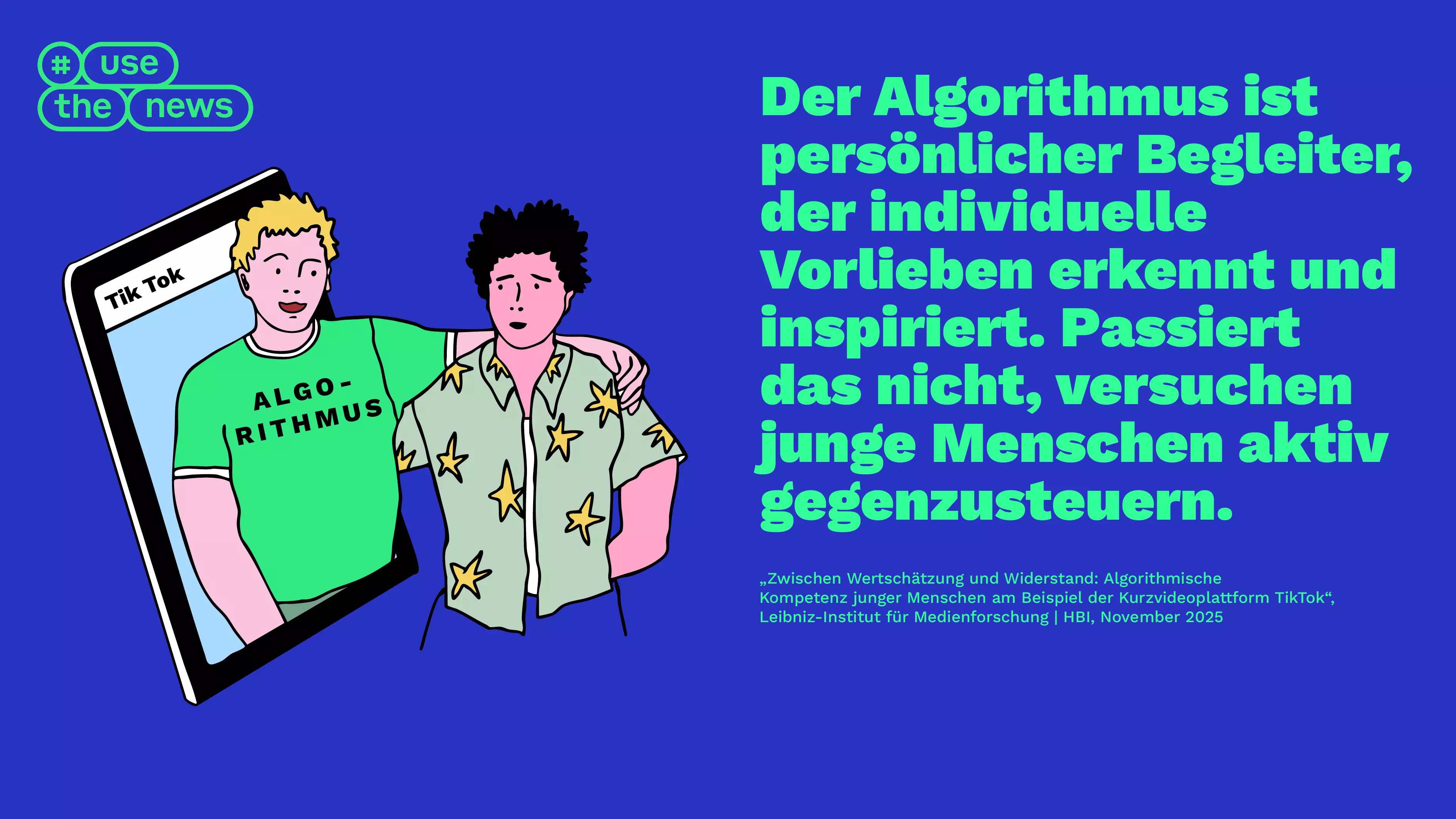

Key findings
Key findings of the study "Between appreciation and resistance: Algorithmic competence of young people using the example of the short video platform TikTok":
- Participants know very little about how TikTok collects and processes information. They have few concerns about disclosing personal data, but as they get older, their understanding of how the platform works grows.
"I've never really thought about the app in general. I just downloaded it, used it and that's it. And I haven't thought about the data either." (male, 16 years old)
- They use the features on the For You Page in a variety of ways, but mostly unconsciously and without intending to influence the TikTok algorithm.
"You just like every video. When it's so personalised, it's the perfect pastime." (female, 16 years old)
- Young people perceive their ability to act as situational and limited. Self-efficacy, such as influencing the algorithm through interaction, is only experienced sporadically. When confronted with inappropriate content, many react with annoyance, discomfort or a loss of control. They then try to actively influence the algorithm or take breaks from using the app. This behaviour is an expression of their desire for autonomy.
"If there's a video that doesn't interest me, I just swipe on and the algorithm shows me less of it." (female, 16 years old)
- Young Users emotionally associate the For You page with positive feelings such as interest, appreciation or entertainment. They experience the algorithm as a personalized companion.
"If I had to personify it, TikTok would be the person that everyone actually likes. Everyone is secretly friends with this person, but when everyone is there, TikTok gets bullied." (female, 20 years old)
- Most respondents find it convenient to passively stay up to date with TikTok content. Few young people actively use TikTok as a source of political information, as they consider the platform to be untrustworthy or not a reputable source.
"I didn't use it for the election because there was too much edited stuff and too many memes in between, but TikTok is great for current news." (male, 22 years old)
"TikTok is one of the main sources of information for young people. This also applies to news and other journalistic offerings on the platform. We supported the study because the media industry needs sound insights into the significance and effectiveness of TikTok if it wants to try out new news formats there." (Vanessa Bitter, Chief Operating Officer of #UseTheNews)
About the survey
The #UseTheNews study was designed, conducted and prepared by Dr. Leonie Alatassi, Dr. Sascha Hölig and Philipp Kessling from the Leibniz Institute for Media Research in Hamburg. To answer the key questions, a qualitative survey was designed, comprising six focus groups (n=31) and follow-up individual interviews with twelve of the participants. The respondents were between 16 and 24 years old.
In each of the three cities of Hamburg, Düsseldorf and Erfurt, one group consisted of teenagers and one of young adults; the groups were mixed in terms of gender and formal education (high vs. low). The participants for the guided individual interviews were recruited from the focus groups. In advance, the participants were given instructions on how to request and download their TikTok data and make selected data available. This data was analysed, visually presented in the form of diagrams and discussed in the interviews. The fieldwork took place from March to May 2025. The study was supported by the Media Authority Hamburg/Schleswig-Holstein.